Short classical excerpt
Students begin with an active reading prompt, source context, vocabulary support, and a focused passage.
 Classical Virtues Homeschool WorkbookPando & Page Press
Method
The series uses a repeated lesson rhythm and a simple top-down answer method: answer first, support with reasons, use evidence, and explain why it matters.
Lesson architecture
Each reading can stand alone, or all five can be used together as a broader study of the volume's core virtue.
Students begin with an active reading prompt, source context, vocabulary support, and a focused passage.
Each reading is placed in time and place so old texts become usable for a modern homeschool week.
Students learn how a text teaches, arranges, persuades, contrasts, repeats, or turns example into judgment.
A visual and historical world gives the reading weight without turning the lesson into a long lecture.
The worksheet teaches students to answer first, support with reasons, use evidence, and explain why it matters.
Writing
Students learn to put the answer first instead of circling toward it. The same four-part structure appears throughout the series.
State the main answer in one clear sentence.
Arrange two or three supporting ideas in a sensible order.
Point to the reading, rhetoric, map, history, or art.
Close by explaining why the answer matters.
Worked example
Parent support begins after the student tries. The goal is one useful prompt and one meaningful revision, not a perfect first draft.
The student begins with the question printed in the workbook.
The answer is direct, but it needs a reason and a precise detail from the reading.
The parent asks one useful question rather than rewriting the answer.
The student now answers first and has a clear path toward reasons and textual evidence.
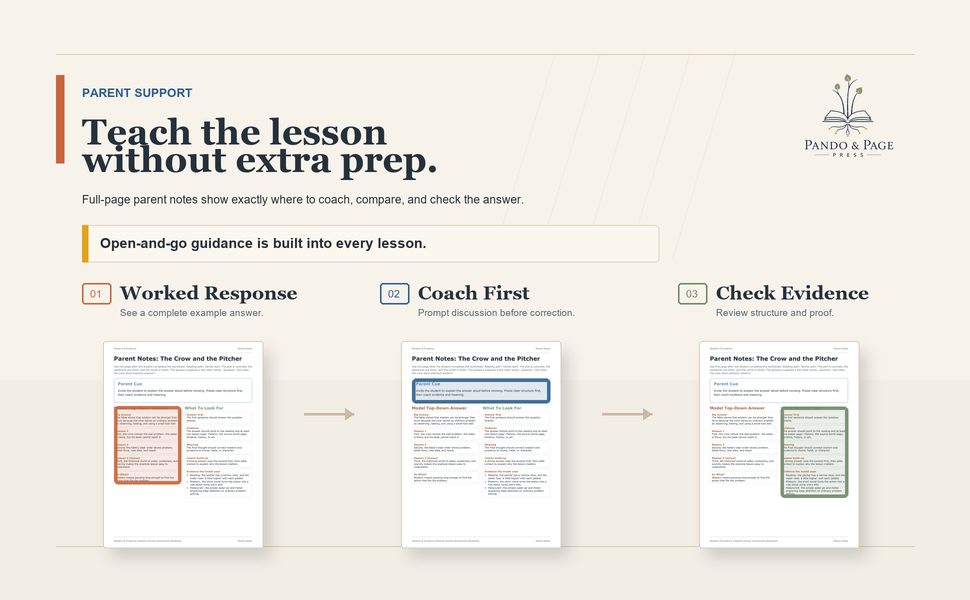
Parent support
No advance parent preparation is required. Parent involvement is recommended because discussion helps students deepen their reading and test their ideas.
Parent notes and model answers give families a clear way to review the work: praise clear structure first, then coach evidence and meaning.
Open the example to inspect it at full size.
Next step
The free PDF places the orientation, student pages, worksheet, and parent model answer together.