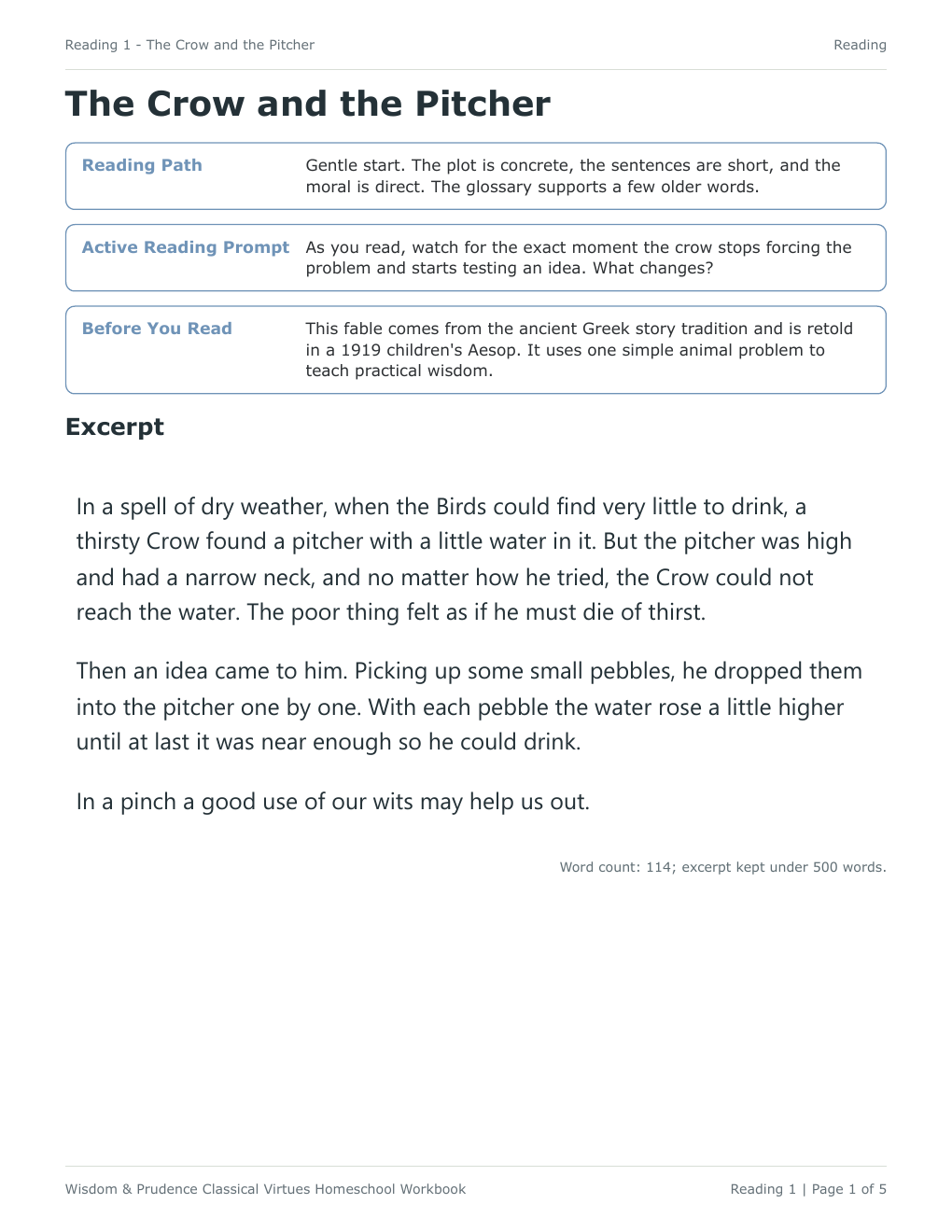
The Crow and the Pitcher
Aesop, retold for children, The Aesop for Children. 114 words.
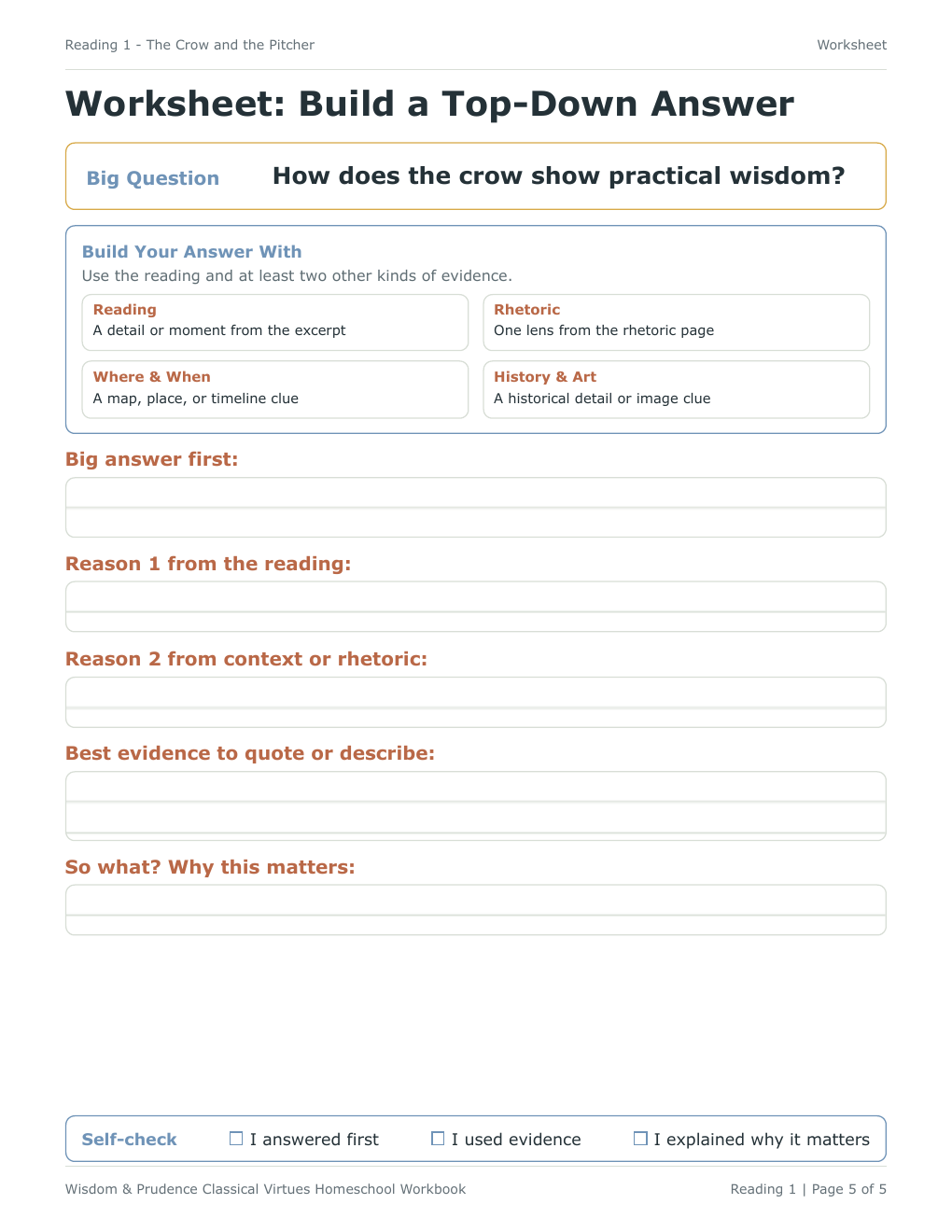
How does the crow show practical wisdom?
 Classical Virtues Homeschool WorkbookPando & Page Press
Volume 1
5 Self-Paced Lessons with Classical Readings and Critical Thinking
Practical judgment, honest self-examination, careful action, wise effort, and care for the soul.
The PDF includes the orientation, complete first lesson, and parent note with model answer.
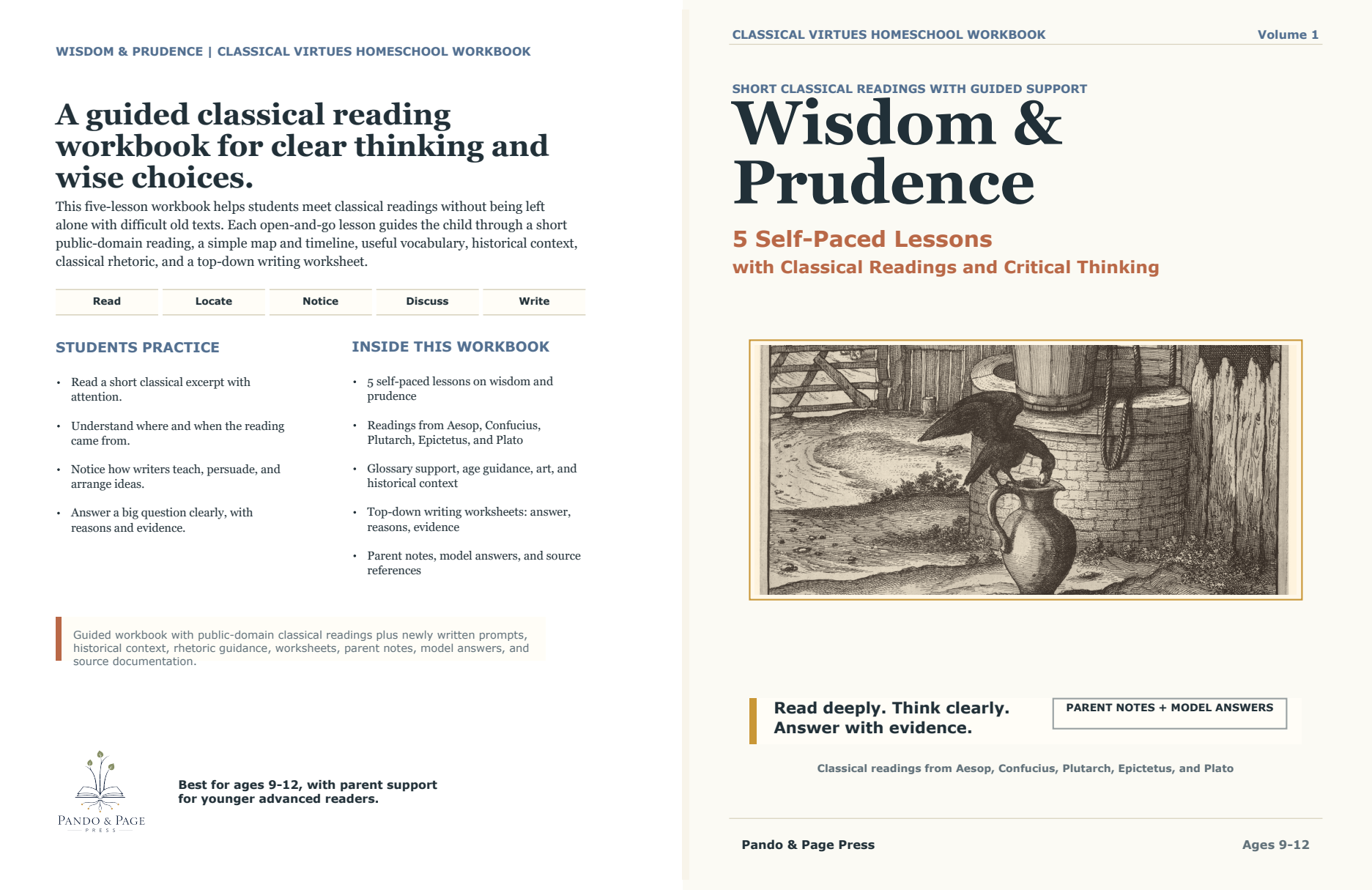
Best for ages 9-12; parent-supported for younger advanced readers.
Grades 4-6.
40-page paperback, 8.5 x 11 inches, designed to be written in.
About 30 minutes per working session.
Each reading can stand alone, or all five can be used together as a broader study of the volume's core virtue.
No advance parent preparation is required. Parent involvement is recommended because discussion helps students deepen their reading and test their ideas.
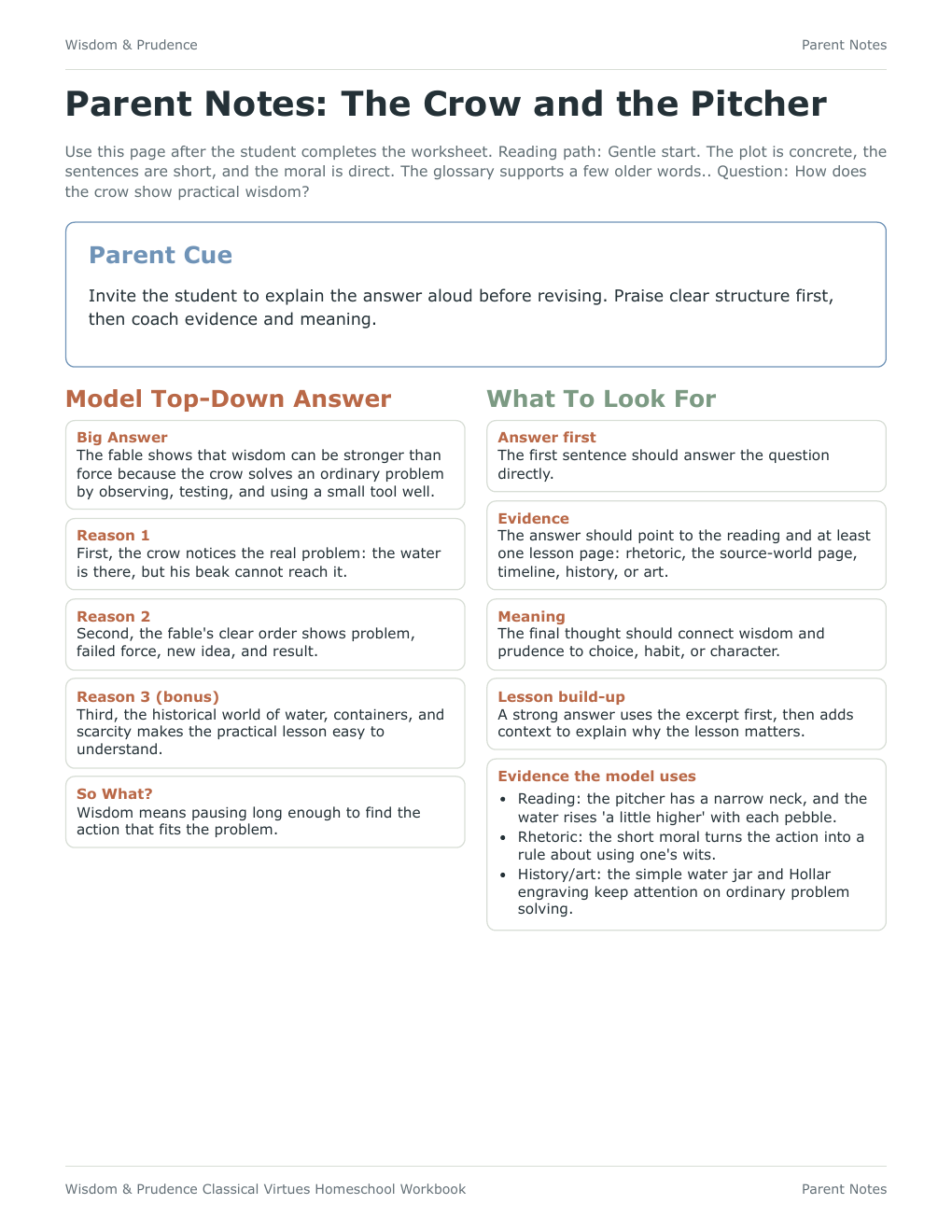
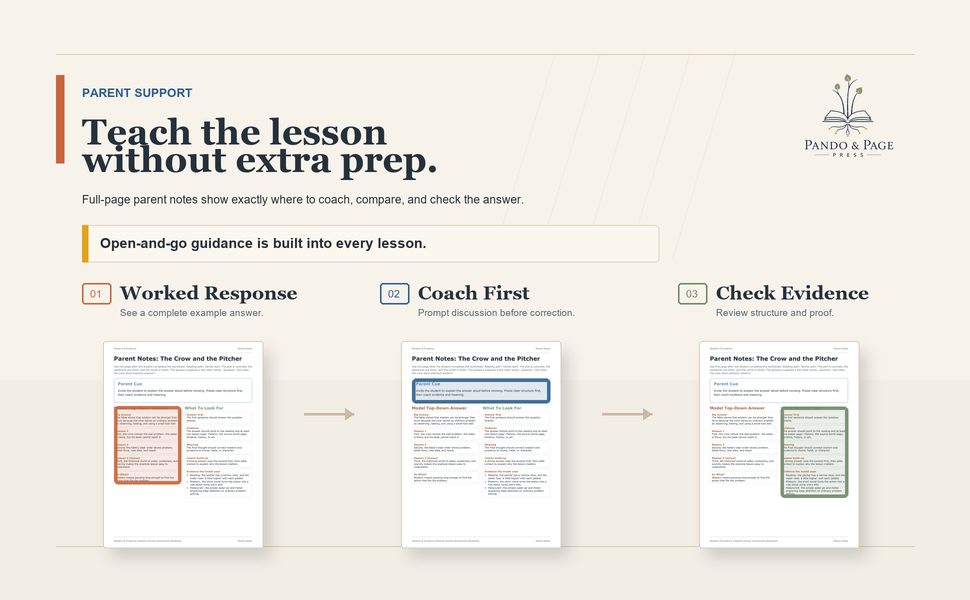
Every reading includes a parent cue and model top-down answer for review after the student attempt.
Free sample
Open any page at full size, or download the PDF to see the method, student work, and parent review together.
About 30 minutes
A session combines reading, conversation, writing practice, and one useful review. No advance parent preparation is required, and discussion is recommended to help students test their ideas.
The student reads the short passage independently or with a parent.
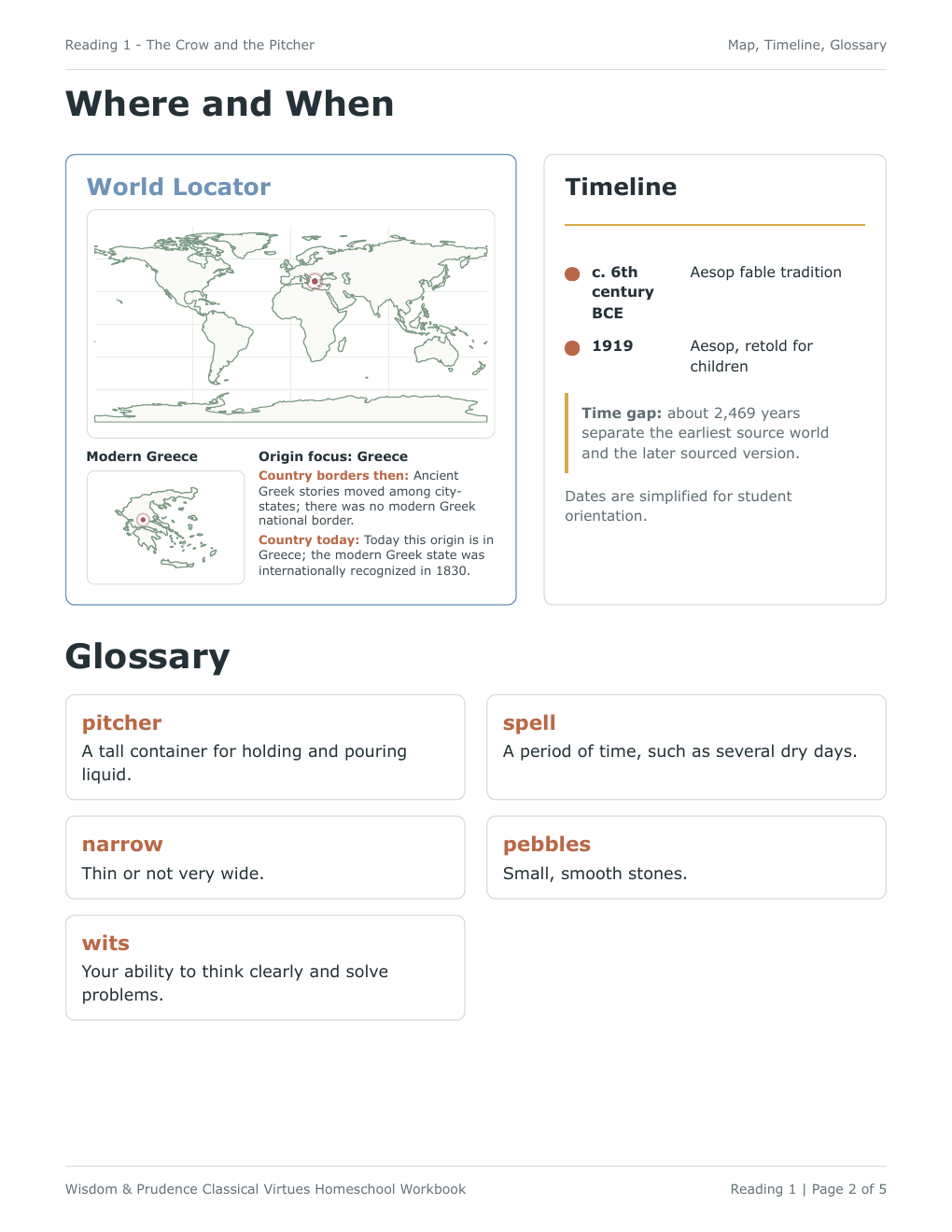
Look at where and when the text comes from, then notice how its words and examples work.
The student practices a top-down answer: answer first, give reasons, use evidence, and explain why it matters.
Use the parent cue and model answer to recognize what worked and coach one useful revision.
Contents
Each reading can stand alone, or all five can be used together as a broader study of the volume's core virtue.
Aesop, retold for children, The Aesop for Children. 114 words.
How does the crow show practical wisdom?
Confucius / Tsang Tzu, The Chinese Classics, Vol. 1: Confucian Analects. 49 words.
How does daily self-examination help a person grow wiser?
Plutarch, Life of Alexander. 432 words.
How does Alexander show careful judgment?
Epictetus, The Enchiridion. 263 words.
How does Epictetus teach us where to spend our effort?
Plato, Apology. 323 words.
Why does Socrates put the soul first?
Inside the workbook
Students begin with an active reading prompt, source context, vocabulary support, and a focused passage.
Each reading is placed in time and place so old texts become usable for a modern homeschool week.
Students learn how a text teaches, arranges, persuades, contrasts, repeats, or turns example into judgment.
A visual and historical world gives the reading weight without turning the lesson into a long lecture.
The worksheet teaches students to answer first, support with reasons, use evidence, and explain why it matters.
Before you buy
Every volume stands alone, so families can begin with the virtue that fits their current study.
Use one volume as a supplement, or combine the series into a virtue-centered course of study.
About 30 minutes per working session. Each reading can stand alone, or all five can be used together as a broader study of the volume's core virtue.
No advance parent preparation is required. Parent involvement is recommended because discussion helps students deepen their reading and test their ideas.
Read or discuss the passage, help the student notice context and rhetoric, then use the parent guide and model answer to review the student's work.
The paperback is designed to be written in, so one consumable copy is recommended per child. That gives each student room to take notes and record a complete response.
The series draws from short public-domain classical and classic readings, with a strong emphasis on familiar works from the Western tradition, including ancient Greece and Rome. Readings come from documented public-domain editions and translations. Retellings, excerpts, translators, source notes, and visual credits are identified inside each workbook.
Families choose when to use each reading and whether to study one reading or all five. Students do the thinking and writing, while parent conversation is recommended.